
David Szalay: Assembling a man
Written by Ebony-Storm Halladay
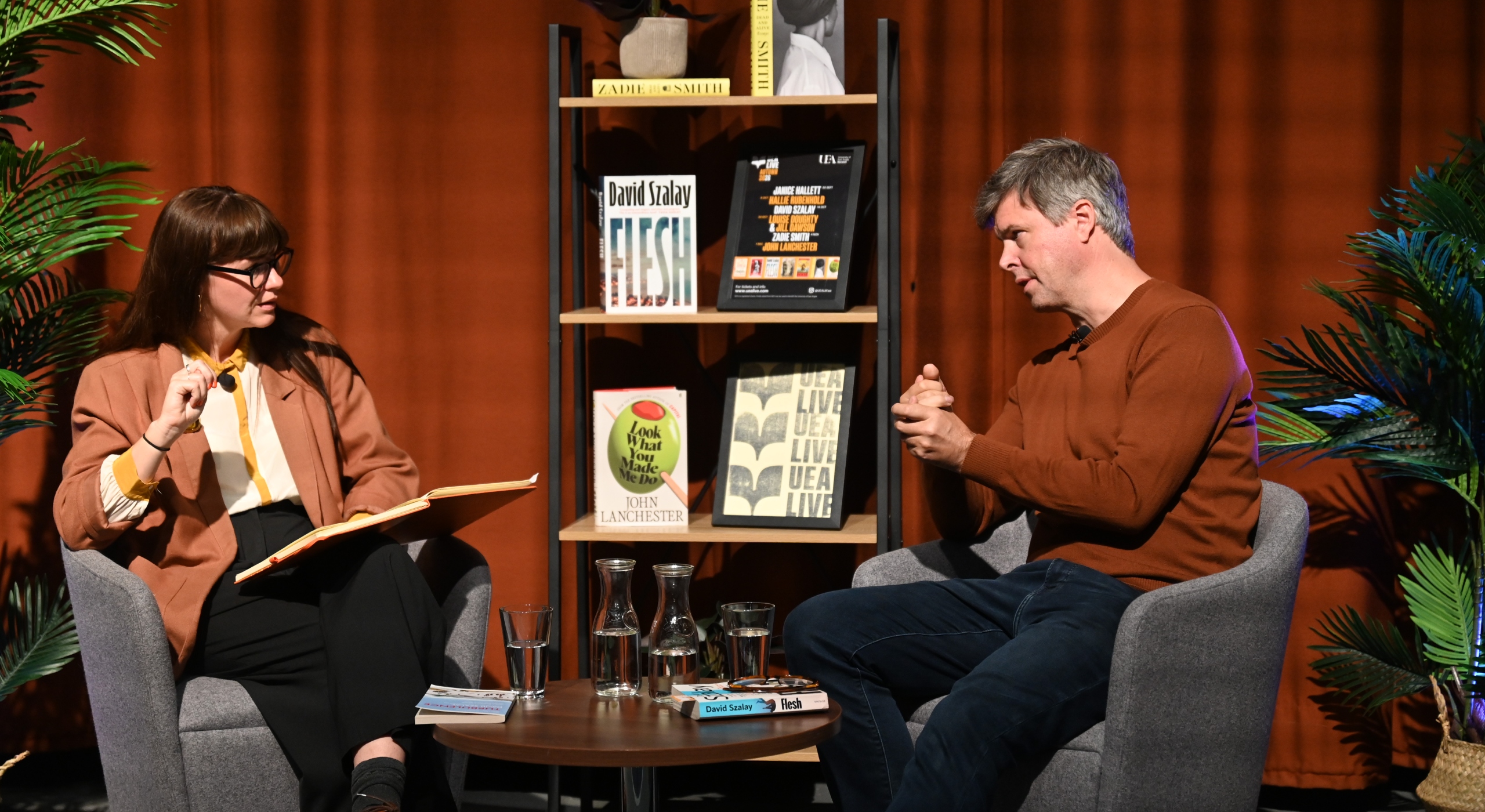
Walking into the lecture theatre on 14 October to hear David Szalay talk about his Booker Prize winning novel, Flesh, I had already been thinking about how relationships shape us.
In Flesh, David Szalay’s sixth novel, we follow István through his life, from his teens in Hungary to adulthood in the upper echelons of British society. Though Flesh can be read as the portrait of a man, it’s the surrounding relationships that bring shape to a dissociated and passive protagonist. I was curious to hear how David Szalay saw the characters that surrounded István, and to what extent they had shaped him.
The lecture hall was fizzing with low conversation before the talk began. Bringing shape to the evening’s conversation was Dr Naomi Wood, novelist and short story writer, and a UEA associate professor in creative writing.
Naomi began with David’s bio, before admitting with a smile just how long it was. The pair and the audience shared a laugh, while David turned away slightly as Naomi finished reading. There was a deference to his gesture that was both disarming and reflective of the narratorial voice in Flesh. In fact, throughout the evening, David’s demeanour echoed the restrained yet elusive qualities of his narrator. I found myself leaning in, determined to read between the lines of conversation.
The talk began in earnest with discussion on style; Flesh’s spare prose and controlled narratorial voice, the limited access to István’s interiority. David noted how an earlier novel of his, Turbulence, had got him ‘in the habit of writing short’. In the early days of Flesh, David revealed, he had also been reading Ultraluminous by Katherine Faw, and the numbness with which the protagonist’s reality was described, the lack of interiority, and expression through exterior occupations, had informed his approach.
Readers of Flesh will know that István is virtually monosyllabic throughout the story, his most common response to any number of scenarios being, ‘okay’. Despite this, Flesh isn’t a novel without feeling – it’s more that feeling is articulated through the body.
David explained that the stripped back style of Flesh was a drive for realism. By keeping the emphasis on physicality, he could be ‘presenting characters like we experience them in reality.’ After this, I couldn’t help but watch David’s physical responses to questions; his posture in the chair, and his facial expressions. How much could I establish about the man in one hour, based on how he appeared on stage? Perhaps it was what he didn’t show that mattered more.
In the novel, István is deeply affected by sexual relationships with women, and violent relationships with men. But, as readers, we don’t get to see the scenes of traumatic action. Instead, we get blank pages and time jumps. As David read a few pages from the beginning of chapter 3, where we see István in Kuwait following his service in Iraq, I was reminded of how Flesh subverts how and what we pay attention to.
Commenting on his decision to omit scenes of action, David acknowledged that he likes the dynamic aspect of juxtaposing passages – it’s ‘not necessarily the banal bits [he] wants to cut… It’s the most dramatic bits.’ When the reader learns about István’s traumatic experiences, it’s through retellings that are shaped by his sharing them with other characters.
By keeping traumatic moments hidden from view, Flesh is reflective of real life, in that we often don’t see the moments of trauma and stages of psychological processing the people around us experience. David went on to describe how, in real life, ‘we have to assemble an idea of somebody’ using the snippets we have. It made me think about the ambition David had articulated earlier in the conversation, to present characters as we experience them in reality.
We get the most detailed picture of István through his close personal relationships, specifically with women. Perhaps David’s most telling answer was in response to Naomi’s question: where are his male friends?
While David was quick to point out that István does have male friends – naming Claudiu, who appears briefly in the story – he made the comment with a glint in his eye and a wry smile, before underlining that ‘male friendship is not nearly as present in the book as his sexual relationships with women.’ I found myself wondering whether, given David’s stylistic choice to incorporate time jumps and blank pages, it’s not István’s relationships with women that are most telling, but the gaps left by his male friendships.
Towards the end of the evening, audience questions spoke to the cyclical nature of the story as well as the prevalence of sexual relationships with older women in David’s novels. In response to the latter question, David was delightfully ambiguous, offering a shrug and the sentiment: ‘stories come to me and I write them down’.
As the talk came to a close with warm applause, I found myself reflecting on the version of István I had assembled as a reader. Somewhat isolated, defined and shaped through sexuality, and steered towards decisive action by his mother and other women in his life. Naomi’s question on male friendship hung in my mind, as I turned up to a live music gig at the UEA’s LCR.
There’s a physicality to concerts; the smell of beer and sweat, brushing shoulders and elbows, bumping into bags, that wouldn’t be out of place in Flesh. I found myself standing behind someone very tall, and with no view of the stage, I started paying attention to the two men on my right. One turned to the other, arm draped over his shoulder, and sang along with the lyric ‘I haven’t got time for you either’, before correcting himself: ‘I have mate. I love you!’
Watching their comfortable physicality with one another, I couldn’t help but wonder how István might have been shaped, had male friendship held a more central role in his life.
Ebony-Storm Halladay is a part-time student on UEA’s prose fiction masters. She’s working on her first novel, alongside her work as a freelance copywriter.